Did an Edo-period “hour” change length between summer and winter?
Six divisions for daylight, and six for night. How did Japanese clocks keep time when the units stretched and shrank with the seasons?
Estimated time for the article text only. Allow extra time for figures, comparisons and interactive exhibits.
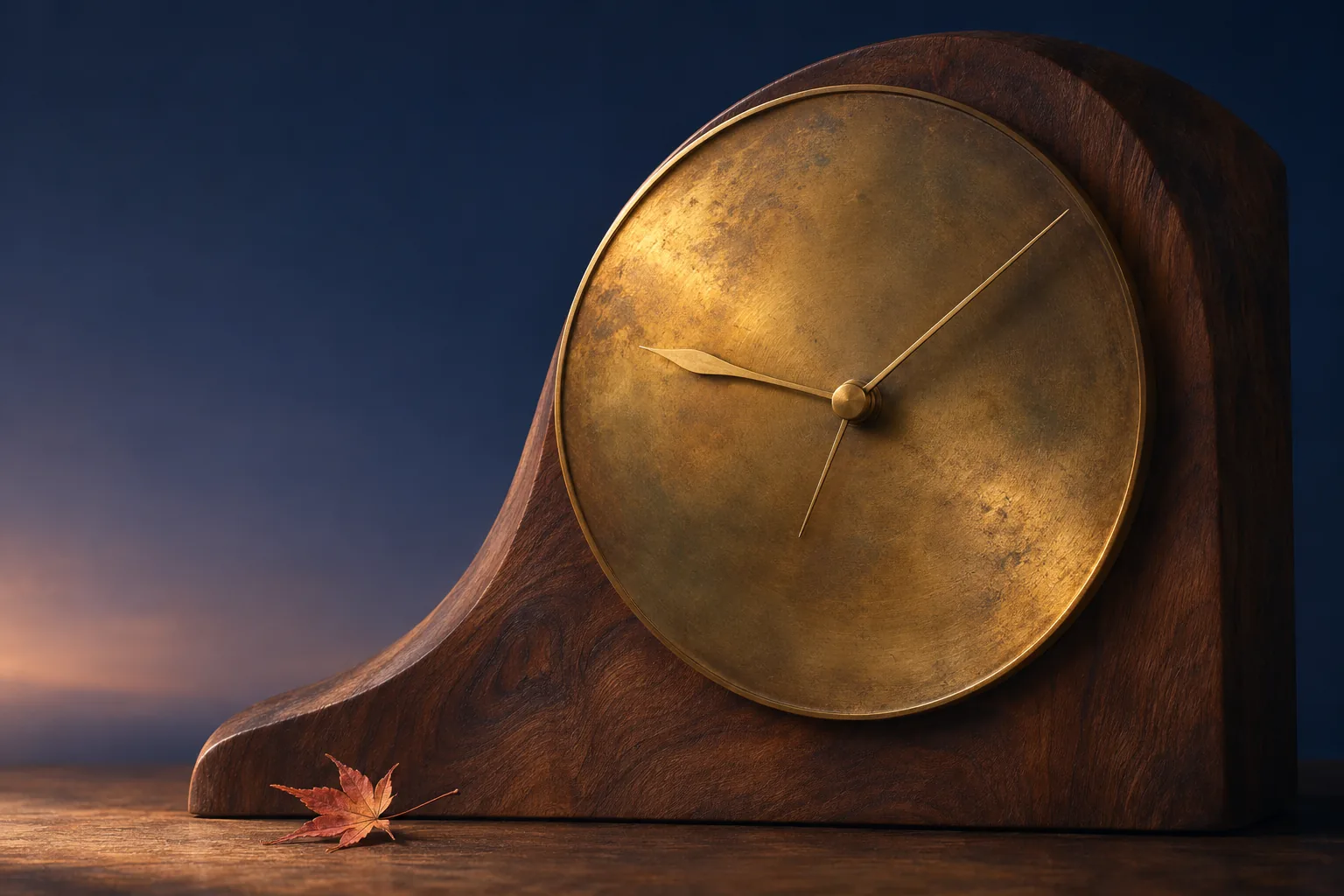
Under the system of unequal hours, an ittoki was one of six equal divisions of either daylight or night. Japanese clocks accommodated these changing lengths by adjusting their speed or the spacing of their hour markers.
Did “wait one ittoki” always mean the same length of time?
With a modern clock, an hour lasts sixty minutes in summer and winter alike. In Edo-period Japan, however, the unit called an ittoki differed in length between day and night, and changed with the seasons. Simply remembering it as about two hours misses what makes it interesting. The system of unequal hours used at the time first separated a day into its light and dark periods, then assigned the same number of divisions to each. The clocks were not running unpredictably. The convention for deciding what to divide equally to create a unit was different from the one we use today.
Time observation station
How do daytime and nighttime ittoki change when you change the length of daylight?
A full 24-hour day stays fixed as one strip. This explanatory model divides daylight into six parts and night into six parts.
An illustrative range of 8–16 hours. You can also adjust it with the arrow keys.
Daytime ittoki140min14 h × 60 min/h ÷ 6
Nighttime ittoki100min10 h × 60 min/h ÷ 6
10 hours of daylight / 14 hours of night
One ittoki lasts 100 min by day/ 140 min by night
12 hours of daylight / 12 hours of night
One ittoki lasts 120 min by day/ 120 min by night
14 hours of daylight / 10 hours of night
One ittoki lasts 140 min by day/ 100 min by night
Only when daylight and night are equally long does an ittoki last 120 minutes in both parts of this model.
Read the sources for this exhibit
Divide the daylight strip into six—and the night strip into six
The boundaries were ake-mutsu at dawn and kure-mutsu at dusk. The interval between them counted as daytime and was divided into six equal parts. The night from kure-mutsu to the next ake-mutsu was also divided into six. When the daylight strip grew longer, each of its six pieces grew longer too. Meanwhile, the night strip shortened, and so did each nighttime ittoki. The crucial point is that daylight and night were not combined and divided into twelve equal parts. Viewing the whole day as a strip of fixed width makes the relationship clear. Moving the boundary stretches and shrinks the day and night sections, but the number of divisions remains six for daylight and six for night.
If daylight lasts 14 hours, how many minutes are in an ittoki?
Let us isolate the arithmetic in a model. Set daylight to 14 hours and night to 10 hours: a daytime ittoki lasts 14 × 60 ÷ 6 = 140 minutes, while a nighttime one lasts 10 × 60 ÷ 6 = 100 minutes. The same named unit differs by 40 minutes. With 12 hours each of daylight and night, both last 120 minutes. Set daylight to 10 hours, and the 100-minute and 140-minute values switch places. These are settings chosen to explain the division rule, not observations of Edo in a particular year. They let you distinguish for yourself when “an ittoki is two hours” applies and when it does not.
“Nine” came twice a day
The names of the hours also worked differently from today’s clock readings. Alongside names based on the twelve zodiac animals, such as the hour of the Rat and the hour of the Ox, another convention called both midnight and noon “nine,” followed by the decreasing numbers eight, seven, six, five, and four. Because the same number appeared twice a day, people distinguished “daytime nine” from “nighttime nine.” It becomes easier to read this system if you separate two questions: how many minutes a unit lasts, and where it falls within the day. Replacing the old numbers with fixed modern clock times, one for one, loses the conditions of day, night, and season.
Give the clock one pace for day and another for night
One way to adapt a mechanical clock to this system was to adjust its running speed. In a bo-tempu, a bar-shaped balance that swings back and forth to regulate the clock, this meant changing the positions of small weights attached to it. A design with just one balance required the weights to be repositioned when day changed to night and vice versa. The Seiko Museum’s collection includes a tower-style yagura clock that automatically switches between separate daytime and nighttime balances. Seasonal adjustments were still needed, but the mechanism reduced the need to reposition the weights twice each day. The way people divided time influenced the clock’s internal construction.
If the hand moves at a constant speed, move the hour markers
Another solution was to move the markings that indicated the hours. On a warigoma dial, small blocks bearing hour labels could slide along a track, changing their spacing to suit the season. Even if the hand moves at a constant speed, it takes longer to reach the next marker when that marker is farther away. Widening or narrowing the divisions in our strip model corresponds to this arrangement. A dial that initially looks unusual becomes a purposeful design once you know the convention behind it: divide daylight and night separately into six equal parts.
Look beyond the hand to the clock’s conventions
Before immediately translating “one ittoki” into 120 minutes, ask whether it is day or night and what season it is. When looking at a Japanese clock, notice not only where its hand points but also its movable hour markers and the parts that switch between day and night. These two perspectives let you read more from the clock. Representing the passage of a day with numbers requires decisions about where its boundaries lie and how many divisions to make. Seeing unequal hours alongside the clocks designed for them reveals how those conventions could change the shape of a machine. Its weights and dial are clues to how people chose to handle time.
Sources and verification notes
This article is an original synthesis of primary sources and explanations from specialist institutions.
Generative AI assists with research, structure and English translation. Claims are compared with sources and editorial checks are performed; independent specialist and native-English reviews have not yet been completed.
- The Seiko Museum GinzaThe system of unequal hours ↗ (opens in a new tab)
- The Seiko Museum GinzaYagura clock with twin balances, alarm, and hakama-shaped base ↗ (opens in a new tab)
- Japan Clock & Watch AssociationThe world of Japanese clocks ↗ (opens in a new tab)
Sources checked:
We checked the division of daylight and night into six parts each, the names of the hours, the switching of balances, and the movable-marker dial against the holding museum’s explanations and collection record, and the Japan Clock & Watch Association’s account. Examples such as 14 hours of daylight and 10 hours of night are our own explanatory settings, not observations for a particular historical date or place. We did not visit, disassemble, or measure the operation of the original clocks.
Rights, status, and revision history
- Status
- Free public edition. Preparation and revision history is retained below.
- 0.1.1
- Rights to the text and diagrams
- The original Japanese text is an independently written summary. The SVG illustrations and conceptual diagrams were newly created. No external images, original source text, or audio recordings are reproduced.
- How sources are used
- Sources are referenced by links only. All rights to each source remain with its respective rights holders.
- · v0.1.0 — Checked primary sources and explanations from specialist institutions, and prepared a private preview article with a guiding question, comparisons, conditions, and references. Added an original explanatory exhibit. Publication has not been approved.
- · v0.1.1 — Added links explaining how to explore the new questions in v15. The existing article text, comparison conditions, sources, and source verification dates are unchanged.
For another read, another day.
THE NEXT BOOK
A new question, on the next shelf.
These paths are editorial comparisons and associations. They do not claim that different subjects work by the same principle.
Can the same time word lead to different meeting days?
For an ittoki, the season and timekeeping system determined its length. Next, place the Japanese word shiasatte on a calendar and compare cases where its meaning differs between speakers. Distinguishing units of time from words that refer to days offers another way to explore shared conventions.
If you agree to meet “shiasatte,” will you arrive on the same day?From dividing a day to organizing a calendar
Here we examined divisions within a day. Next, move to the calendar that counts the days, and explore, at a different scale, the systems that support our everyday tools for handling time.
Month 12, day 2—then New Year’s Day. Where did the missing dates go?Try asking what stays the same when you compare maps
Comparing daylight and night required distinguishing the whole day from the number of divisions within it. With maps, appearances can change even when the original areas are equal. The mechanisms differ, but you can carry the habit of checking comparison conditions from one to the other.
How much truth is there in "big" on a map?From a changing ittoki to a shared noon across Japan
An Edo-period ittoki was a unit that followed the seasons. Next, explore the convention that synchronizes clocks in different places. If the clocks show the same time, does that mean the Sun is in the same position too?
When all of Japan says noon, why doesn't the Sun?