Did humanity evolve along a single path?
Footprints, bones, tools and DNA reveal different parts of our past. Combine them, and a single procession becomes a history of branching lineages, movement and encounters.
Estimated time for the article text only. Allow extra time for figures, comparisons and interactive exhibits.
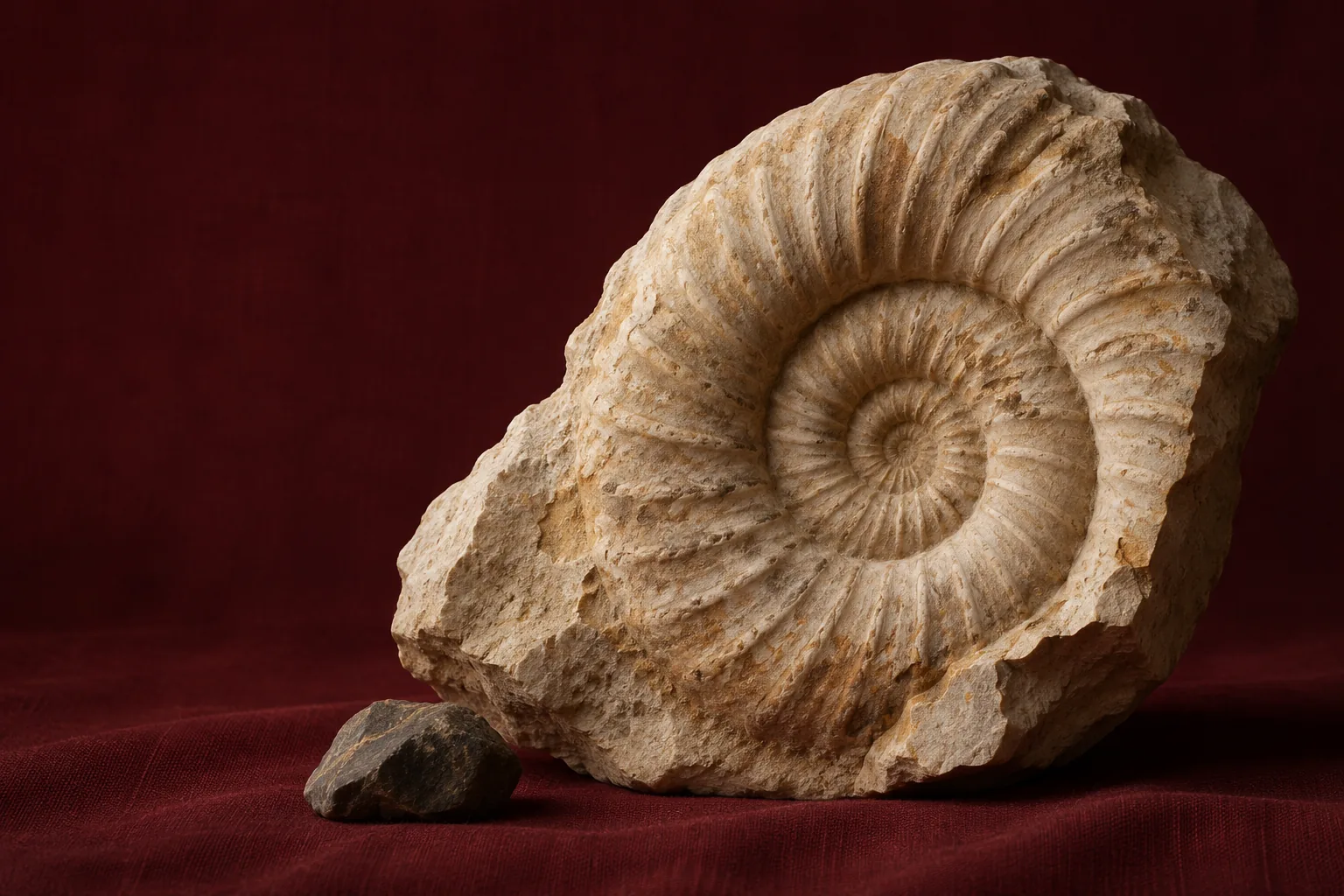
Human history is not a staircase leading in one line to people today. Changes in bodies, branching and interacting populations, technologies and movement are reconstructed by combining fossils, artifacts, DNA and dating evidence.
Can a line of marching figures tell our story?
A crouching ape, then a slightly taller figure, then a fully upright modern person: this familiar procession may come to mind when we hear “human evolution.” Yet the picture removes relatives that lived at the same time and lineages that ended. The record does not show every earlier human transforming, in sequence, into the next figure on the way to us.
We belong to one species, Homo sapiens, within the great apes and the wider group of primates. Living chimpanzees did not turn into humans. Our lineage and those of chimpanzees and bonobos diverged from shared ancestors in the past. The first step is to avoid turning neighboring branches alive today into an ancestor and its descendant.
The human story also asks when and where people lived and what they did. This chapter changes its tools as it follows those questions: bones, footprints, stone tools and DNA. Rather than inspecting a finished family tree, we are adding to a map using evidence that reveals different parts of the journey.
The time recorded in a trail of footprints
At Laetoli in Tanzania, footprints were preserved in volcanic ash about 3.6 million years ago. The big toe points broadly in the same direction as the other toes, and the trails record walking on two feet. Australopithecus afarensis is considered a likely maker, but footprints do not come with a species name. That identification combines the tracks with fossils from the same region and period.
To investigate walking from bones, researchers look beyond the shape of the head. They examine how the pelvis, thigh bones and knees supported the body. Each step briefly puts weight onto one leg; the structures that bear those forces provide clues to movement. Some early humans combined adaptations for walking on the ground with features useful for climbing.
Upright walking, large brains, tools and language were not a set of equipment acquired together on one day. Different characteristics have different histories. Finding a walking trail cannot establish what language its maker spoke or what they believed. Distinguish what the evidence directly supports from the scene we might imagine around it.
LOOK CLOSER · COMPARE THE EVIDENCE
Different clues at one site answer different questions
Bones and teeth
- What it can directly investigate
- Body form and traces of growth or movement
- What it cannot establish alone
- The language spoken or the individual’s thoughts
Tools, pigments and footprints
- What it can directly investigate
- Manufacture, movement of materials and traces of behavior
- What it cannot establish alone
- The maker’s species or every meaning of the action
Ancient DNA
- What it can directly investigate
- Genetic relationships and traces of gene flow
- What it cannot establish alone
- The circumstances of encounters or the history of every population
Layers and dating methods
- What it can directly investigate
- Sequences and age ranges from suitable materials
- What it cannot establish alone
- A first person’s birthday without checking how the materials are related
An editorial comparison of evidence types. Cross-check methods and excavated contexts to understand the limits of an inference.
Evidence for this comparison
- Smithsonian National Museum of Natural History — Human Evolution ↗ (opens in a new tab)
- Smithsonian Human Origins Program — Dating ↗ (opens in a new tab)
- Smithsonian Human Origins Program — Ancient DNA and Neanderthals ↗ (opens in a new tab)
- Smithsonian Human Origins Program — Evolution of Human Innovation ↗ (opens in a new tab)
Bones, tools and DNA answer different questions
Suppose an excavation yields a tooth, a stone tool and a burned stone. The tooth can reveal bodily features, the tool an act of manufacture, and the heated stone an opportunity to estimate an age. But if their positions and layers have been disturbed, we cannot simply assign all three to the same person's day. Excavators record locations closely because the relationships among finds are themselves evidence.
Dating methods also answer different questions. The order of layers establishes sequences; methods using radioactive isotopes and other physical properties estimate ages from suitable materials. Dating volcanic ash above and below a fossil is different from dating the object itself. The result is often an estimate with uncertainty, not a single point like a recorded birthday.
DNA offers powerful evidence of ancestry and connections between populations, but it breaks down over time. It cannot be recovered from every fossil, and preservation conditions matter. Surviving samples are not a complete register of everyone who lived. A blank area on our map need not prove an absence of people: evidence may remain undiscovered, or may not have survived.
How familiar is a face from about 300,000 years ago?
Jebel Irhoud in Morocco is an important site for understanding Homo sapiens. Research reported in 2017 examined heated stone tools from the same deposits as the fossils, among other evidence, and placed the finds at about 300,000 years ago. Faces and teeth had features close to those of people today, while the shape of the braincase retained differences.
Observing a familiar-looking face is not the same as concluding that every modern human characteristic appeared at that instant. Changes in the face, skull, body and behavior need not have been controlled by a single switch. Researchers compare combinations of traits when debating how fossils fit into the history of our lineage.
The approximate age does not mark the birthday of a first person in that cave. It is significant evidence that people associated with this lineage lived there at that time. An exceptionally early find marks how far back our surviving record currently reaches, rather than revealing the beginning itself. New finds and dating work can redraw that outline.
Why one pin cannot mark our African origins
Fossils and genetics support an African origin for our species. The harder question is which populations across that vast continent were connected, when, and how. “An African origin” is not the same claim as “everyone arose from one small, isolated population in one place.”
A study reported in 2023 compared models of population history using genomes from people living in Africa today. It proposed a model in which ancestral populations that differed only weakly continued to exchange genes over long periods. For the data examined, populations that diverged while maintaining connections offered a better explanation than completely isolated branches.
This was not a direct census of ancient people. The data used and the assumed patterns of migration and branching affect the inference. Instead of placing a bold pin labeled “birthplace” on a map, we can distinguish fossil locations, connections suggested by genetic models, and unresolved areas. The resolution of the evidence should govern how precise an address we assign to our origins.
Evidence that separated branches met again
Human lineages sometimes separated, and their descendants sometimes met again. Ancient DNA research demonstrates genetic exchange involving Homo sapiens, Neanderthals and Denisovans. A simple picture in which one population appears and replaces another without any contact cannot account for all the evidence.
A small bone fragment from Denisova Cave in Russia makes this especially tangible. Research published in 2018 showed that it belonged to a young individual whose mother was a Neanderthal and whose father was a Denisovan. Evidence of interaction between populations acquired the concrete form of one individual's parents.
DNA can reveal that relationship without telling us everything about the encounter or the lives of the people involved. Nor can we turn lineage names into present-day nationalities, ethnic categories or a ranking of ability. What the evidence shows is one aspect of a long history: boundaries between populations were not always complete walls.
A distant stone can reveal an invisible connection
If bones preserve a history of bodies, transported materials preserve a history of behavior. At sites in Kenya's Olorgesailie Basin dating to roughly 320,000 years ago, researchers found obsidian that was not available locally. Comparing the stone's chemical characteristics with geological sources showed that material had arrived from several distant places. Processed pigments also occur in the record from this period.
These observations support the possibility of networks through which objects and relationships moved between groups. But establishing a distant origin for stone is different from reconstructing the terms of an exchange. Some material might have been collected directly and some passed between people. Likewise, surviving pigment does not automatically reveal what it colored or what it meant.
The findings nevertheless deepen the question. Choosing stone, remembering a sequence of actions, learning from others, and passing knowledge onward connect technological objects with social life. A history made only of lone inventors is inadequate. Following the routes of materials and knowledge, alongside the finished tools, offers a way into the history of culture.
Read a migration map as more than one arrow
The expansion of humans around the world was not a line drawn once on a map. Human populations older than Homo sapiens had already lived outside Africa. When studying our own species, we must distinguish evidence of occupation at a site, genetic relationships, and the routes people actually traveled. Knowing that people were present somewhere does not reveal their entire itinerary.
At Madjedbebe in northern Australia, excavation and dating research reported occupation around 65,000 years ago, with an uncertainty of about 5,000 years. The methods included estimating how long it had been since sand grains were last exposed to light. This is an estimate for a site's history, not a record of the first landing place or the date of a voyage.
At White Sands in North America, researchers tested the age of footprints initially placed at about 23,000–21,000 years ago. Dating aquatic plant seeds raised concerns about older carbon affecting the result. A 2023 study compared dates from terrestrial pollen and luminescence measurements of sediment, supporting the original age framework. The discovery did not end with “old footprints found.” Asking what the numbers actually measured helped test the history those footprints imply.
One species, many lives today
Every person living on Earth belongs to Homo sapiens. Differences in where people live, their skin color, languages, tools or institutions do not divide humanity into “unfinished evolution” and a “completed form.” No living community is an unchanged fossil from the past. All have histories of their own.
Consider two different maps. One follows genetic connections from parents to children. The other follows languages, crops, techniques and knowledge between people. These maps interact, but their lines need not coincide. You do not have to be someone's child to learn a way of making a tool from them.
Drawing ancient journeys too tightly within today's national borders can hide old connections. Saying only that everyone is the same can also erase distinct local experiences. Keep both a shared origin and diverse histories in view as we turn to the next chapter: changes in how people obtained their food.
Where does farming fit within the longer human story?
For a simple comparison, use rounded spans of about 300,000 years for Homo sapiens and about 12,000 years when discussing the beginnings of farming. Dividing 12,000 by 300,000 gives 4%. On a line with a uniform time scale, the period from the early emergence of farming to the present occupies a short final portion of our species' history. This is an illustrative ratio, not a calculation that fixes either beginning to a single day.
The long period before it was not an empty wait for civilization. Bodies adapted to walking, ways of finding food, movement, tools and relationships across distance already had histories. People before farming were not incapable of change, and farming did not turn later people into a different biological species.
Reading from human origins into civilization means moving between bodily evolution and changes in ways of life. The next question is not when humans became “complete,” but how growing particular foods, settling in particular places and sharing resources changed possibilities and burdens. We change the scale of observation from deep time to the dinner table and the work of the seasons.
Sources and verification notes
This article is an original synthesis of primary sources and explanations from specialist institutions.
Generative AI assists with research, structure and English translation. Claims are compared with sources and editorial checks are performed; independent specialist and native-English reviews have not yet been completed.
- Smithsonian National Museum of Natural HistoryHuman Evolution ↗ (opens in a new tab)
- Smithsonian Human Origins ProgramGenetics ↗ (opens in a new tab)
- Smithsonian Human Origins ProgramWalking Upright ↗ (opens in a new tab)
- Smithsonian Human Origins ProgramLaetoli Footprint Trails ↗ (opens in a new tab)
- Smithsonian Human Origins ProgramDating ↗ (opens in a new tab)
- Smithsonian Human Origins ProgramHomo sapiens ↗ (opens in a new tab)
- Max Planck SocietyThe first of our kind ↗ (opens in a new tab)
- University of California, DavisNew model for human evolution suggests Homo sapiens arose from multiple closely related populations ↗ (opens in a new tab)
- Smithsonian Human Origins ProgramAncient DNA and Neanderthals ↗ (opens in a new tab)
- Max Planck SocietyNeandertal mother, Denisovan father! ↗ (opens in a new tab)
- Smithsonian Human Origins ProgramEvolution of Human Innovation ↗ (opens in a new tab)
- Australian Research CouncilUncovering a new history of Australian habitation ↗ (opens in a new tab)
- U.S. Geological Survey / Pigati et al., Science (2023)Independent age estimates resolve the controversy of ancient human footprints at White Sands ↗ (opens in a new tab)
- Smithsonian Human Origins ProgramOne Species, Living Worldwide ↗ (opens in a new tab)
Sources checked:
Read and compared Smithsonian exhibit and research explanations; research-institution releases on Jebel Irhoud and Denisova Cave; UC Davis’s 2023 population-history model; the Australian Research Council’s Madjedbebe report; and the USGS account of the White Sands dating reassessment. Historical “oldest” claims and single-location origins are not generalized. Uncertainty in classification, models and migration routes is retained. The ratio using 300,000 and 12,000 years is an illustrative calculation with rounded inputs. This is not a reanalysis of complete excavation records or every paper’s supplementary data.
Rights, status, and revision history
- Status
- Free public edition. Preparation and revision history is retained below.
- 0.1.0
- Rights to the text and diagrams
- The original Japanese text is an independently written summary. The SVG illustrations and conceptual diagrams were newly created. No external images, original source text, or audio recordings are reproduced.
- How sources are used
- Sources are referenced by links only. All rights to each source remain with its respective rights holders.
- · v0.1.0 — Created a private preview chapter for the permanent Earth, humanity and civilization feature, checking primary sources. Formal publication has not been approved.
For another read, another day.
THE NEXT BOOK
A new question, on the next shelf.
These paths are editorial comparisons and associations. They do not claim that different subjects work by the same principle.
From gathering food to tending it
As people spread, they encountered different organisms in different places. Next, separate using wild plants, cultivating them and their transformation into crops.
Why did people start growing their food?Before following migration arrows, inspect the map
A migration map also translates a curved Earth onto a flat surface. Check how projections change apparent size before comparing distances or continents by eye.
How much truth is there in "big" on a map?Let another body change your frame of reference
Our upright bodies have a particular history. Another animal’s circulation shows why the human body need not be the sole benchmark for how bodies work.
An octopus's three hearts work as a team.