Why is life so varied? Branching bodies and mass extinctions
Visit Cambrian seas, expanding life on land and two mass extinctions. Comparing the recoveries reveals a history of changing bodies, environments and relationships, with no single path toward a superior organism.
Estimated time for the article text only. Allow extra time for figures, comparisons and interactive exhibits.
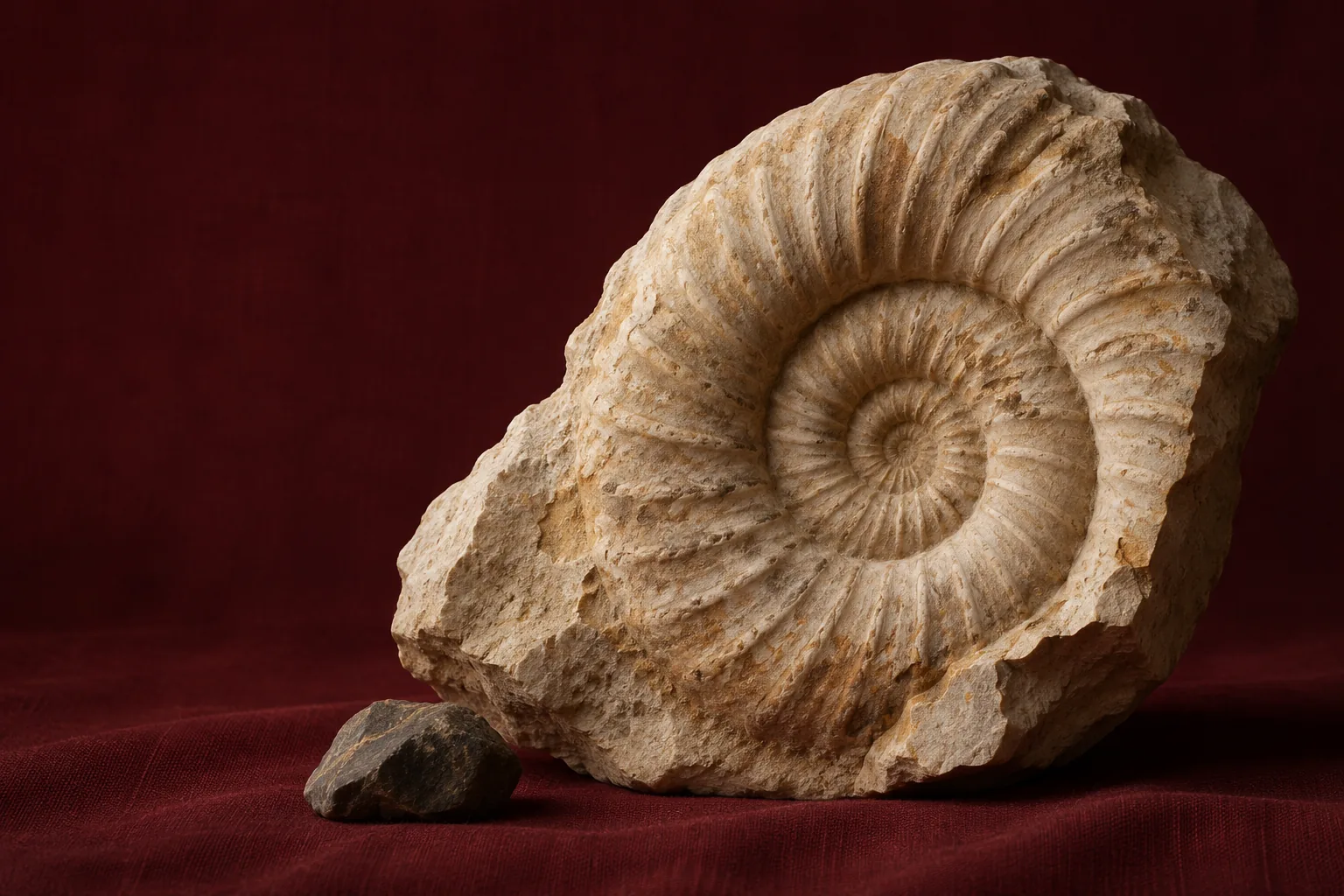
Diversification involves branching histories of bodies, ways of living and environmental relationships. Checking preservation and measuring extinction and recovery separately lets us understand many surviving lineages without placing humans at the top.
The sea was inhabited before the “explosion”
Walk through an exhibition of life’s history and unfamiliar animals appear in succession: shelled bodies, burrowers and swimmers. Yet starting life itself with the Cambrian Explosion would erase billions of years of microbial history. The diversification of animals and the origin of life need different exhibit labels.
Before the Cambrian, the Ediacaran already supported varied organisms large enough to see without a microscope. Fossils resembling branching fronds, ribbons or quilted forms occur in sedimentary rocks around the world. Some remain difficult to place in relation to living animal groups. That uncertainty does not make them unfinished bodies; it means their surviving features are difficult to interpret.
Instead of asking what an ancient organism was on its way to becoming, ask how it lived with the body it had. Did it use particles from the water, or move across microbial mats? Combining body shape, traces of movement and surrounding sediment can bring the everyday lives of unfamiliar organisms into focus.
How sudden was the Cambrian Explosion?
The Cambrian, beginning roughly 540 million years ago, records a striking diversification of animal bodies and ways of living. Hard structures such as shells and spines, burrowing through sediment and active feeding relationships changed the marine world. “Explosion” describes the geologically rapid pace of this diversification.
It was not an instant in which every kind of animal appeared. The changes extended over millions of years, and the interval depends on which events define its beginning and end. Features associated with many major animal lineages appeared during this period, but today’s species did not all arrive together. Species continued to originate and disappear afterward.
On a timeline where one centimetre represents a million years, moving just ten centimetres spans ten million years. This is a scale calculation, not an assertion that the explosion lasted exactly that long. Geological descriptions of rapid change need an explicit measuring scale. The International Commission on Stratigraphy’s June 2026 chart places the beginning of the Cambrian at about 538.8 million years ago, with uncertainty. This chapter’s “roughly 540 million years” is a rounded guide.
LOOK CLOSER · COMPARE THE EVIDENCE
Two mass extinctions, different evidence and mechanisms
Main clues to investigate
- End-Permian: about 252 million years ago
- Huge volcanism, warming, ocean oxygen conditions and fossil distributions
- End-Cretaceous: about 66 million years ago
- An impact crater, iridium-rich layers and the timing of extinction
Mechanism explored here
- End-Permian: about 252 million years ago
- Warmer water combines reduced oxygen supply with increased animal demand
- End-Cretaceous: about 66 million years ago
- Atmospheric material reduces sunlight, affecting photosynthesis and food relationships
Questions that remain
- End-Permian: about 252 million years ago
- How much other changes, including acidification, contributed
- End-Cretaceous: about 66 million years ago
- Which effects affected which organisms, and for how long
Care in interpretation
- End-Permian: about 252 million years ago
- One ocean model is not the sole explanation for every organism’s extinction
- End-Cretaceous: about 66 million years ago
- Separate devastation at the impact site from effects on distant ecosystems
An editorial guide to the two case studies later in this chapter, comparing evidence and mechanisms. It is not a list of every mass extinction. Dates are rounded.
Evidence for this comparison
- International Commission on Stratigraphy — International Chronostratigraphic Chart, v2026/06 ↗ (opens in a new tab)
- University of Washington — Biggest extinction in Earth’s history caused by global warming leaving ocean animals gasping for breath ↗ (opens in a new tab)
- Natural History Museum, London — How an asteroid ended the age of the dinosaurs ↗ (opens in a new tab)
More fossils do not automatically mean proportionally more life
Imagine building a future museum using only the shells and bones collected from today’s ocean. Shelled animals might be prominent, while soft-bodied organisms could be far less visible than they were in the living sea. A fossil record combines what lived with a second filter: what survived after death.
Canada’s Burgess Shale is celebrated for exceptional preservation, including soft tissues. Such deposits reveal organisms and aspects of communities that ordinary preservation often leaves out. It is rather like moving from a directory of only certain buildings to an archive containing more of the town’s inhabitants.
An increase in fossil types can therefore prompt several questions: did organisms diversify, did hard parts evolve, or did conditions of preservation change? Comparisons would be easier if every environment preserved life equally well. Real rocks do not. Treating the Cambrian diversification as entirely an illusion of preservation would be inadequate, but so would equating fossil counts directly with the abundance or diversity of the original living community.
Read relationships as branching ancestry, not a ranking
Putting a fish, a frog, a lizard, a mammal and a human in a row can make the right-hand end look more advanced. Living animals are not a display of successive stages in our own ancestry. Lineages have branched from shared ancestors and continued along their own histories. The position of a tip on a family tree does not rank its abilities.
To understand change, think across generations. Individuals in a population differ in inherited traits. Some differences affect survival or reproduction in a particular environment, changing the proportions inherited by later generations. This is the basis of natural selection. Mutation, chance changes in genetic frequencies and movement of genes between populations also contribute to evolution. Organisms do not look ahead to a goal and redesign themselves to reach it.
When reading a tree, follow shared ancestry rather than judging which labels sit next to one another. A 2016 biology-education study examined the persistence of interpreting trees as ladders of progress. Supporting a body in water, retaining water in dry air and finding food in dark mud present different challenges. No single measure of ability can place all organisms in one ascending order.
Living on land means facing the problem of water loss
Compare life in water with life on land. Land offers illuminated surfaces but also the risk of drying out. Taking up water and nutrients, moving them around a body, supporting that body and reproducing all operate under different conditions. The short phrase “colonizing land” contains a collection of practical challenges.
Plant history did not begin with a complete forest of roots, trunks, leaves and seeds. Early small land plants preceded lineages with increasingly varied structures and internal transport systems; forests appeared during the Devonian. The terrestrial histories of arthropods and vertebrates also cannot be reduced to the same single move out of water.
Relationships with fungi add another dimension. Research published in 2025 examined approximately 407-million-year-old Scottish fossils and identified a structure within plant tissues associated with nutrient exchange with a fungus. It offers evidence of an ancient symbiotic relationship, without dating the very first such association. The spread of life on land involved relationships between organisms as well as changes in individual bodies.
Forests and flowers change other organisms’ lives
When a new feature spreads within a lineage, does only that organism change? Larger plants alter shade, surfaces and available food. Organisms adapt to environments, but their own activities also change the environments encountered by others.
Flowering plants and animals provide a familiar example. Animals visiting flowers may transfer pollen while obtaining food. Animals eating fruits can move seeds to new places. Plant reproduction and animal feeding become connected, so each partner’s traits and distribution can influence the other’s life. This does not mean all plants use the same methods of pollination or dispersal.
Counting species alone misses part of this diversity. A community in which many species use similar foods differs from one in which the same number of species uses different resources underground, in the canopy and along water margins. This is a conceptual comparison, not a measured result from a particular forest. Life’s history involves changing relationships—feeding, transporting and modifying habitats—as well as additional names on a species list.
End-Permian: an ocean can remain while habitable conditions vanish
Life’s history contains large losses as well as diversification. Around 252 million years ago, at the end of the Permian, a mass extinction struck marine and terrestrial organisms. Huge volcanic activity in what is now Siberia and associated environmental changes, including warming, provide major clues to its causes.
A 2018 study combined models of ancient ocean conditions with animal oxygen requirements and fossil distributions. Warmer water holds less oxygen, while many marine animals need more oxygen as metabolism increases with temperature. When supply decreases as demand rises, a habitat can become unsuitable before oxygen falls all the way to zero.
The explanation goes beyond noticing that warming and extinction occurred together. A proposed mechanism can predict which settings and physiological traits should be associated with greater losses, then be compared with fossils. The study supported warming and oxygen limitation as a major mechanism, without claiming that one factor explained every extinction. Other changes, including acidification, remain relevant. An ocean still being present is different from suitable ocean habitat still being available to a particular animal.
End-Cretaceous: one impact disrupted food supplies far away
Around 66 million years ago, at the end of the Cretaceous, a large asteroid struck near what is now Mexico. The Chicxulub crater and iridium-rich layers found around the world support a connection between a major impact and mass extinction. This was not simply a repetition of the end-Permian event with the same cause.
To understand distant effects, follow sunlight and food rather than only the point of impact. Material entering the atmosphere could reduce light reaching the surface, suppressing photosynthetic production. Effects could spread through organisms feeding on plants or plankton and then to their consumers. The consequences extended far beyond the area physically struck.
The phrase “dinosaurs went extinct” also needs care. Non-avian dinosaurs disappeared, but birds are surviving dinosaur lineages. Mammals did not suddenly originate after the impact; they already existed, and surviving lineages diversified afterward. Researchers continue to investigate differences in survival and the duration of particular effects. Knowing which lineages survived does not mean that those winners were predetermined.
A recovered ecosystem is not a copy of the previous world
If greenery returns after an extinction, has the ecosystem recovered? Vegetation cover, species richness, the return of large animals and the complexity of feeding relationships are different measures. They need not recover at the same rate, and extinct species do not simply reappear.
A 2019 study of fossils from the Corral Bluffs area of Colorado followed plants and mammals through approximately the first million years after the end-Cretaceous extinction. Within about 100,000 years, maximum mammalian body mass had approached its pre-extinction level; later changes included larger mammals, different diets and changing plant communities. These are observations from a particular study region, not a recovery timetable applying everywhere on Earth.
The study shows why “mammals became large because dinosaurs disappeared” is incomplete. Available foods, changing vegetation and climate also need investigation. Recovery involves more than filling empty positions. Surviving lineages assemble new relationships under changed conditions, rather than returning the same cast of species to an unchanged stage.
Keep the other branches in view as we turn toward humans
Earth’s history has not moved in one constant direction. Bodies and ways of living diversified, many lineages ended, and different relationships emerged afterward. Fossils preserve this history unevenly. A single line across a timeline cannot fully express those overlapping changes.
As we turn to humans, there is no need to thicken our branch and erase all the others into the background. Birds, insects, fungi and microbes each have histories continuing into the present. Comparing human cognition or tools is different from ranking the value of all organisms. Choose a particular feature to suit the question.
A bird overhead belongs to dinosaur lineages that survived extinction. Beneath a tree, imagine relationships with fungi as well as the plant’s visible body. At an aquarium, compare ways of obtaining food and delivering oxygen. Deep history can change how we see the organisms around us today. Next, fossils, tools and evidence of movement will guide us along one of those many branches: the human story.
Sources and verification notes
This article is an original synthesis of primary sources and explanations from specialist institutions.
Generative AI assists with research, structure and English translation. Claims are compared with sources and editorial checks are performed; independent specialist and native-English reviews have not yet been completed.
- Smithsonian National Museum of Natural HistoryEarly Life on Earth – Animal Origins ↗ (opens in a new tab)
- International Commission on StratigraphyInternational Chronostratigraphic Chart, v2026/06 ↗ (opens in a new tab)
- Royal Ontario MuseumThe Cambrian Explosion: Uniqueness and Timing ↗ (opens in a new tab)
- Royal Ontario MuseumThe Burgess Shale: The Fossils ↗ (opens in a new tab)
- Kummer, Whipple & Jensen / Journal of Microbiology & Biology EducationPrevalence and Persistence of Misconceptions in Tree Thinking ↗ (opens in a new tab)
- Natural History Museum, LondonWhat is natural selection? ↗ (opens in a new tab)
- US National Park Service (NPS)Diversification of Life ↗ (opens in a new tab)
- Natural History Museum, LondonAncient fossil reveals how plants and fungi first developed on land ↗ (opens in a new tab)
- University of WashingtonBiggest extinction in Earth’s history caused by global warming leaving ocean animals gasping for breath ↗ (opens in a new tab)
- Natural History Museum, LondonHow an asteroid ended the age of the dinosaurs ↗ (opens in a new tab)
- Lyson et al. / Science, annotated by Science in the ClassroomExceptional continental record of biotic recovery after the Cretaceous–Paleogene mass extinction ↗ (opens in a new tab)
Sources checked:
Checked Smithsonian, ROM and NPS exhibit material; NHM researchers’ explanations; the university report of the end-Permian mechanism study; the 2019 recovery paper presented by Science in the Classroom; and research on interpreting evolutionary trees. Geological dates were checked against the ICS June 2026 PDF, rather than copying older Cambrian dates on museum pages. No single extinction percentage is adopted, and the end-Permian event is not assigned one exclusive cause. Corral Bluffs recovery rates are treated as regional findings. The timeline-scale example and comparison table are editorial explanations.
Rights, status, and revision history
- Status
- Free public edition. Preparation and revision history is retained below.
- 0.1.0
- Rights to the text and diagrams
- The original Japanese text is an independently written summary. The SVG illustrations and conceptual diagrams were newly created. No external images, original source text, or audio recordings are reproduced.
- How sources are used
- Sources are referenced by links only. All rights to each source remain with its respective rights holders.
- · v0.1.0 — Created a private preview chapter for the permanent Earth, humanity and civilization feature, checking primary sources. Formal publication has not been approved.
For another read, another day.
THE NEXT BOOK
A new question, on the next shelf.
These paths are editorial comparisons and associations. They do not claim that different subjects work by the same principle.
Follow the human branch through fossils and movement
With evolution understood as branching ancestry, explore multiple human lineages and the evidence for their journeys.
Did humanity evolve along a single path?What do an octopus’s three hearts each do?
Compare bodies through what their organs do, not just how many they have. Follow oxygen transport into an animal’s way of life.
An octopus's three hearts work as a team.Meet soil organisms through the smell of rain
Large animals are not the only protagonists of Earth’s history. A familiar rainy day can reveal processes involving soil microbes.
The smell of rain, revisited: can tiny bubbles carry bacteria, too?