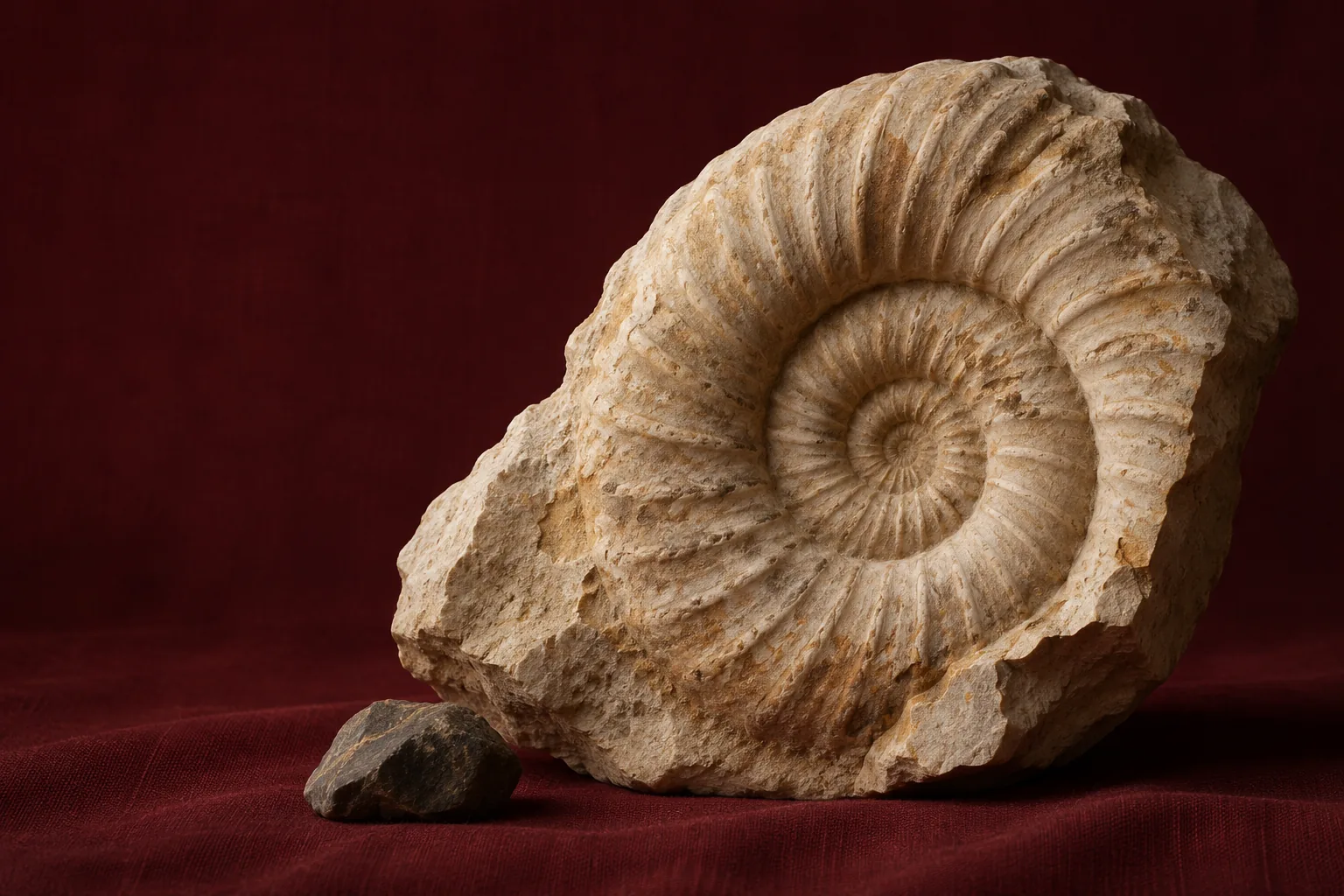
Rocks and fossils
Ask what survived and in which layer. Read age measurements alongside interpretations of the traces.
Go to the related chapterCENTRAL LIBRARY · PERMANENT FEATURE
A planet takes shape. Life persists. People change the world.
Walk through deep time in seven chapters. Follow rocks, fossils, tools and writing—and ask how we know.
Begin with any chapter. Each offers a route back and a detour to another part of the library.
OBSERVATION ROOM 01 · CHANGE THE SCALE
Fit Earth’s history into one width, and the markers for humans and writing crowd near the right edge. Change the time window and compare the spacing.
Within each window, distance is proportional to time. The four windows are viewing choices, not four official starting dates. The size of a dot does not represent a duration or an uncertainty range.
Start with Earth’s history in one width.
All seven selected markers fit in this window.
Enlarge a more recent part of Earth’s history.
Markers outside the window are not moved to an edge. Choose a longer window to see them.
Change the scale as you enter the human chapters.
Markers outside the window are not moved to an edge. Choose a longer window to see them.
Look more closely at changes in life and record-keeping.
Markers outside the window are not moved to an edge. Choose a longer window to see them.
An estimated age, preserved evidence, a geological boundary, a regional record: identifying the kind of marker helps show what a timeline can tell us.
Positions use a display model with 2026 as the present. Geological and prehistoric ages are approximate. Around 3200 BCE is rounded to about 5,200 years ago; 1777 is 2026−1777 = 249 years ago. These are not unconverted radiocarbon BP dates, whose reference year is 1950.
About 4.54 billion years ago
A representative estimate used to place Earth’s formation. The dot does not mean the planet was completed at one instant.
U.S. Geological Survey · Powell Expedition—Geologic Time. Then and Now.
About 3.48 billion years ago
Researchers examine layered rock structures as evidence of biological activity. This dates preserved evidence; it does not establish the moment life began.
Natural History Museum, London · The oldest evidence of life on Earth could help us discover ancient life on Mars
About 538.8 million years ago (±0.6 million)
The numerical age listed by the ICS for a boundary defined in a reference rock section. It is not a date on which all animals appeared.
International Commission on Stratigraphy · Global Boundary Stratotype Sections and Points — Fortunian
About 66 million years ago
A time when many groups, including non-avian dinosaurs, disappeared. Extinction was not a planned stage on a path toward humans.
Smithsonian National Museum of Natural History · Extinction Over Time
From about 300,000 years ago
The approximate beginning of our species’ timespan in the Smithsonian account. It does not mark one first person or one precisely located birthplace.
Smithsonian Human Origins Program · Homo sapiens
Around 3200 BCE (roughly 5,200 years ago)
A regional example of early writing, rounded to about 5,200 years ago for this display. Writing did not begin everywhere in the same year.
The Metropolitan Museum of Art · The Origins of Writing
1777 (249 years before 2026)
One concrete example of Boulton and Watt’s steam engines. Its construction year is not a simultaneous worldwide starting date for industrialization.
Science Museum Group · Climate and the collection
Marker sources checked: November 6, 2026
SEVEN CHAPTERS · BEGIN WITH A QUESTION
Read in sequence to connect the questions across time, or explore whichever chapter interests you now.
A planet and its oceans
Use meteorites, rocks and the Moon to investigate Earth’s age and the story of its water.
Life and its environment
Tiny cells leave large questions. Separate evidence of past life from the mystery of its origin.
Diversification and extinction
Follow changing bodies, feeding relationships and habitats through fossils, branching lineages and extinctions.
Human origins and journeys
Bring fossils, tools and genetic evidence together to explore human movements and encounters.
Food and changing ways of life
Gathering, hunting, tending and growing: explore different combinations, choices and costs.
Cities and writing
Explore cities, writing and states across regions, asking how people organized life and kept records.
A connected world
Follow trade, knowledge and energy, alongside coercion, unequal gains and environmental change.
OBSERVATION ROOM 02 · FOLLOW THE EVIDENCE
Different clues reveal different parts of the past. Compare what each can tell us—and what remains uncertain—as you read.
Ask what survived and in which layer. Read age measurements alongside interpretations of the traces.
Go to the related chapterObjects, inherited information and places of encounter provide different views of human history.
Go to the related chapterAsk who recorded something and why. Set written accounts beside evidence from homes and food.
Go to the related chapterBACK INTO THE LIBRARY · FOLLOW ANOTHER QUESTION
Return to familiar tools and conventions with a wider view of their history. The rest of the library remains yours to explore.
Sharing a time
When people cooperate across distances, what makes “twelve o’clock” the same time?
Read the articlePutting knowledge on paper
Move from preserving words to arranging and printing a line. Explore the work behind readable text.
Read the articleMeasuring a spoonful
Move from the history of food to your kitchen. What quantity does the number on a spoon measure?
Read the article