When was Earth “made”? From rock clocks to clues about oceans
A planet’s age, a mineral’s age and evidence for water are different records. Follow Solar System materials, the Moon’s origin and tiny zircons to investigate how a watery planet took shape.
Estimated time for the article text only. Allow extra time for figures, comparisons and interactive exhibits.
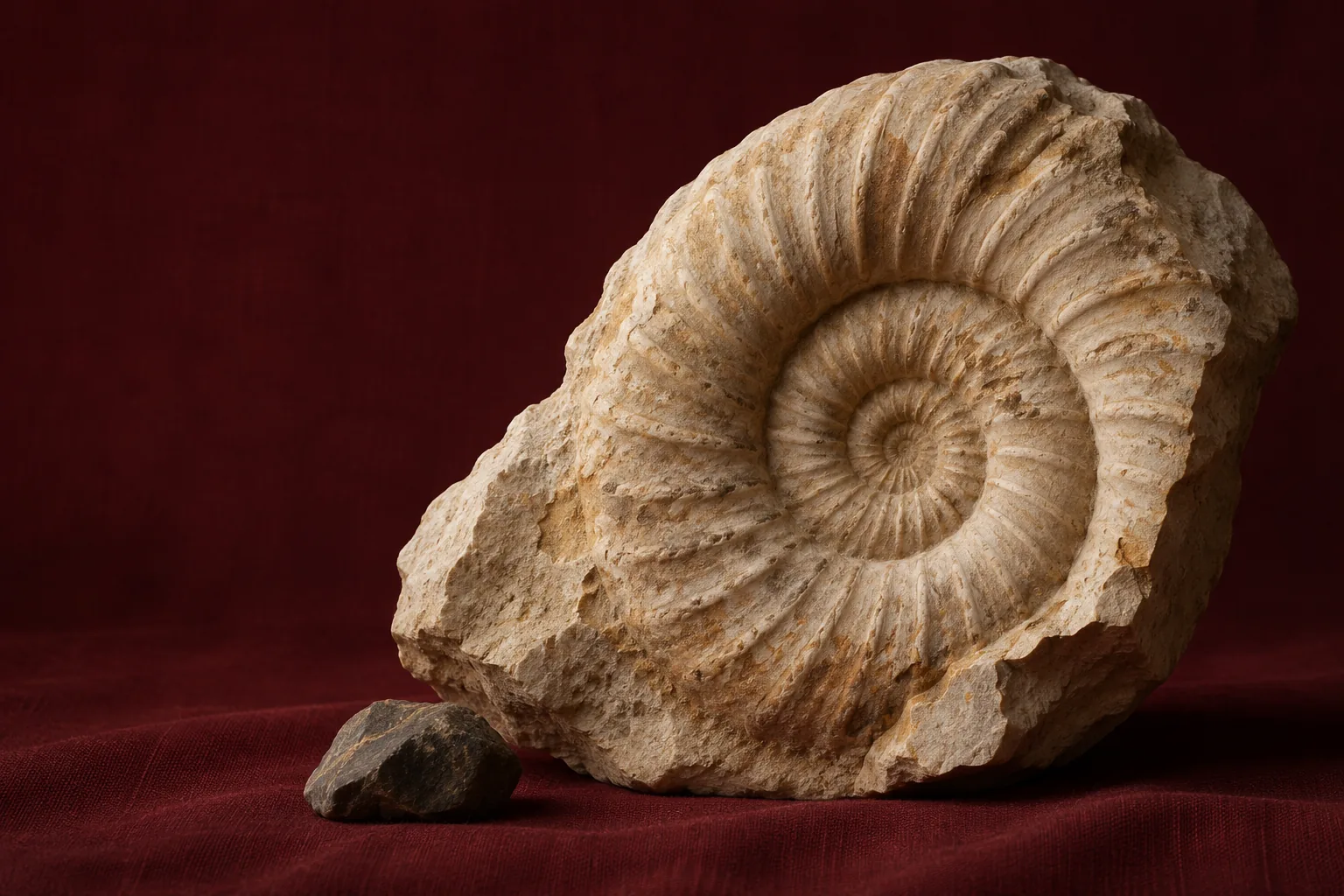
Earth’s formation about 4.54 billion years ago is an estimate assembled from multiple samples and dating methods. Mineral crystallization, evidence for liquid water and signs of life answer different questions.
What does Earth’s “birthday” actually date?
Pick up a stone and you will not find Earth’s birthday written on it. How can we assign an age to a planet that formed long before anyone could observe it? Part of the answer lies in atoms inside minerals. NIST describes an estimate of about 4.54 billion years, with an uncertainty of roughly 50 million years, obtained using minerals from Earth, the Moon and meteorites.
Earth did not become a finished planet on a single morning. Material accumulated, the interior separated into layers, collisions rearranged it, and the surface cooled. Each process took time. “Earth formed” compresses that extended assembly into a short phrase. Imagining present-day continents, oceans and air in place from the beginning would give us a misleading starting point.
In this chapter, we put the planet’s formation, the crystallization of a mineral and evidence for liquid water on separate labels. Rather than memorize a large number, ask what that number measures. Events billions of years old acquire an outline when several surviving clues can be brought together.
The ingredients began in a disk around a young star
As the Solar System formed, a disk containing gas and fine solid particles surrounded the young Sun. Material accumulated into larger bodies, eventually producing rocky planets such as Earth. Collisions could join bodies, but they could also break material apart or redistribute it. Think of an assembly process that repeatedly rearranged its ingredients, rather than finished planets being placed in predetermined positions.
Ancient Solar System rocks are not our only evidence. ALMA has observed a disk with bright and dark rings around the young star HL Tauri. This is not a photograph of Earth’s own past. It is a different system that lets astronomers compare observed structures with calculations of planet formation.
“Rings have been observed” and “a completed Earth-like planet occupies every ring” are different claims. An observation reveals how material is distributed; a model tries to explain how that distribution developed. Looking at a distant star and examining a nearby meteorite approach the same question from different directions.
LOOK CLOSER · COMPARE THE EVIDENCE
Different kinds of age come from different records
Mineral ages from meteorites, Earth and the Moon
- What it can constrain
- The timing of Solar System materials and Earth’s formation
- What it cannot establish on its own
- One rock’s age is not automatically the birthday of the whole planet
A zircon’s age and oxygen isotopes
- What it can constrain
- Past interaction between surface material and liquid water
- What it cannot establish on its own
- The first moment an ocean formed, or its depth and area
The chemistry of lunar rocks
- What it can constrain
- Comparisons between models of the Earth–Moon origin
- What it cannot establish on its own
- A unique answer for every impact parameter, including timing, angle and composition
A disk around another young star
- What it can constrain
- The distribution of material during planet formation
- What it cannot establish on its own
- Direct proof that the Solar System formed with the same details
An editorial comparison of dating, chemical analysis and observation. The rows answer different questions; they are not a ranking of evidential strength.
Evidence for this comparison
- National Institute of Standards and Technology (NIST) — How Do You Know the Age of Fossils and Other Old Things? ↗ (opens in a new tab)
- Wilde et al. / Nature (abstract in PubMed) — Evidence from detrital zircons for the existence of continental crust and oceans on the Earth 4.4 Gyr ago ↗ (opens in a new tab)
- Natural History Museum, London — How did the Moon form? ↗ (opens in a new tab)
- European Southern Observatory (ESO) — Revolutionary ALMA Image Reveals Planetary Genesis ↗ (opens in a new tab)
A hot interior can coexist with solid ground
Earth is not a uniform ball of rock. It has a dense, mainly iron core, a rocky mantle and a thin crust. Boundaries based on chemical composition also differ from boundaries based on mechanical behavior. A tectonic plate includes the crust and the rigid outermost part of the mantle beneath it.
A hot interior does not mean that everything below a thin surface is a sea of magma. Most of the present-day mantle is solid. Under high temperature and pressure, rock can be rigid over short intervals yet deform slowly over geological time. The liquid outer core and a mostly solid mantle that flows over long periods should not be merged into the same image of molten material.
We should also distinguish Earth’s early cooling from its present internal structure. The surface became solid without the interior losing all its heat. Planet formation belongs to the distant past, but the subsequent escape of heat remains connected to the active Earth of volcanoes and mountains.
A rock clock uses atoms instead of hands
Radiometric dating uses the transformation of unstable atoms into other atoms over time. Researchers measure the proportions of the original isotope and its decay products, then combine those measurements with the rate of decay. A half-life is the time in which half of a large population of the original atoms decays. It does not mean that individual atoms change on the same schedule.
Imagine a closed model starting with 100 units of a parent isotope. After one half-life, 50 remain on average; after two, 25; after three, the remaining fraction corresponds to 12.5. Each interval halves what is still present, rather than removing another 50 units. These are explanatory calculations, not measurements of a particular rock.
Real samples require attention to initial components and later changes caused by heat or fluids. Which mineral, which clock and which event does an age describe? The carbon-14 clock used for relatively recent biological remains is not simply extended back to Earth’s formation. The isotope and material must suit the timescale under investigation.
An ancient mineral and an ancient planet have different ages
When a volcano makes new rock, the planet itself does not become younger. Likewise, an old grain inside sandstone need not have the same age as the sandstone assembled from it. The formation of a component, its deposition and its later alteration can leave different records.
Tectonic and volcanic processes repeatedly remake Earth’s surface. Material recording the planet’s beginning has not simply remained intact everywhere. Researchers therefore combine terrestrial minerals with evidence from the Moon and meteorites. Rocks from beyond Earth help us investigate Earth’s own formation.
When reading a museum label, add a second question after “How old is this?”: “How long since what happened?” Distinguishing crystallization from the deposition of a layer allows one specimen to contain several histories. It also prevents a single very old measurement from being mistaken for a direct reading of the entire planet’s birthday.
The Moon is another volume of Earth’s early history
The leading explanation for the Moon’s origin involves a giant impact on the early Earth. Material released by the collision is thought to have formed the Moon. Chemical similarities revealed by lunar samples, including those from Apollo missions, provide important evidence that the two bodies have a connected history.
“A giant impact is the leading explanation” does not mean that every condition of the collision is settled. The impactor’s size and composition, the angle and timing of impact, and the mixing of material affect the outcome. Researchers investigate how well a model can account for several lunar characteristics together. A dramatic animation is a visualization of a scenario, not an observation of the original event.
Reading lunar rocks also means investigating early events through a record beyond Earth. When you look at the Moon, consider it as a partner in reconstructing our planet’s past. Its origin and the reason it now keeps roughly the same face toward us are related topics to explore, but they are different questions.
A tiny zircon carries clues about water
Some zircon grains from Jack Hills in Western Australia are about 4.4 billion years old. A 2001 study examined their age, oxygen isotopes and chemistry. The researchers interpreted the evidence as indicating that material altered by low-temperature interaction with liquid water had contributed to the magma from which a zircon formed. It is an important clue to liquid water on the early Earth.
The grain does not contain an entire ancient ocean. Its age is one measurement; its connection to water is an interpretation of chemical evidence. Together they help reconstruct the history of material before the mineral crystallized. They do not directly measure the ocean’s area, depth or location.
Do not turn “evidence for water about 4.4 billion years ago” into “the ocean first formed in that year.” Evidence for existence is not necessarily evidence for the first moment of existence. A small mineral constrains the larger question of when, and over how much of the surface, liquid water could coexist with a young planet’s hot interior.
Where water came from is not the same question as when oceans formed
Water poses at least two questions. Where did its ingredients come from? And when did liquid water collect on the surface of the planet containing those ingredients? The first concerns origins and supply; the second also depends on temperature, pressure and the movement of water. “Water came from space” does not describe the whole route to an ocean.
Analyses of meteorites resembling Earth’s building materials investigate whether hydrogen was present during formation. Researchers also study contributions from later asteroids and comets. Comparing hydrogen isotope ratios provides clues to sources, but a similar ratio does not uniquely establish either a source or the amount it supplied.
A NASA account of research on Comet 67P illustrates the problem: accounting for dust in the observed gas changed the interpretation of its water’s isotope ratio. What was measured affects the history inferred. Rather than declare that a single source supplied everything, we distinguish starting materials, later delivery, release from the interior and condensation as conditions cooled.
The planet keeps rewriting its surface
Oceans and solid ground did not freeze the stage in place. Plates separate, converge and slide past one another. Crust is made in some settings and recycled into the interior in others. A single fixed world map hides this long history of movement.
Imagine two pairs of maps. One depicts today’s Earth using different projections. The other reconstructs continents at different times. In the first pair, the representation changes; in the second, the arrangement being represented changes. A difference in shape alone does not tell us which kind of change occurred.
Surface activity also affects preservation. Rocks can be destroyed or altered, leaving gaps in the early record. Missing evidence must not be mistaken for a period in which nothing happened. Reconstructing Earth’s history involves studying both the events and the ways their records have survived.
A watery planet raises a further question: was it alive?
We have followed accumulating material, the differentiation of the interior, mineral clocks, lunar samples and clues to water. These sources all concern the past, but they do not date the same events. Keeping planetary age, evidence for water and the extent of an ocean on separate labels makes it easier to distinguish established findings from ongoing questions.
If we prepare three labels—“Earth formed,” “liquid water was present” and “life existed”—each needs its own evidence. Water alone does not demonstrate life. Identifying life adds the harder task of deciding whether a structure or chemical signature was produced biologically.
Earth was not assembled according to a blueprint aimed at the eventual appearance of humans. Organisms subsequently lived within the conditions of a changing planet and altered those conditions themselves. Before rushing to place one date on “the first life,” the next chapter asks how traces of life can be read from rocks.
Sources and verification notes
This article is an original synthesis of primary sources and explanations from specialist institutions.
Generative AI assists with research, structure and English translation. Claims are compared with sources and editorial checks are performed; independent specialist and native-English reviews have not yet been completed.
- National Institute of Standards and Technology (NIST)How Do You Know the Age of Fossils and Other Old Things? ↗ (opens in a new tab)
- US National Park Service (NPS)Radiometric Age Dating ↗ (opens in a new tab)
- NASAFacts About Earth ↗ (opens in a new tab)
- European Southern Observatory (ESO)Revolutionary ALMA Image Reveals Planetary Genesis ↗ (opens in a new tab)
- US National Park Service (NPS)Inner Earth Model ↗ (opens in a new tab)
- Natural History Museum, LondonHow did the Moon form? ↗ (opens in a new tab)
- Wilde et al. / Nature (abstract in PubMed)Evidence from detrital zircons for the existence of continental crust and oceans on the Earth 4.4 Gyr ago ↗ (opens in a new tab)
- University of OxfordScientists find evidence that overturns theories of the origin of water on Earth ↗ (opens in a new tab)
- NASANASA-Led Team Links Comet Water to Earth’s Oceans ↗ (opens in a new tab)
Sources checked:
Checked the NIST and NPS dating explanations; NASA, ESO and NPS material on planets and Earth’s interior; the Natural History Museum’s account of Moon formation; the PubMed abstract of the 2001 zircon study; and institutional accounts of the 2024 comet study and 2025 meteorite-hydrogen research. This does not claim a full-text review of the zircon paper. The chapter does not assign a single confirmed date to the first ocean and retains uncertainty about water sources and impact details. The half-life sequence 100 → 50 → 25 is an original explanatory calculation.
Rights, status, and revision history
- Status
- Free public edition. Preparation and revision history is retained below.
- 0.1.0
- Rights to the text and diagrams
- The original Japanese text is an independently written summary. The SVG illustrations and conceptual diagrams were newly created. No external images, original source text, or audio recordings are reproduced.
- How sources are used
- Sources are referenced by links only. All rights to each source remain with its respective rights holders.
- · v0.1.0 — Created a private preview chapter for the permanent Earth, humanity and civilization feature, checking primary sources. Formal publication has not been approved.
For another read, another day.
THE NEXT BOOK
A new question, on the next shelf.
These paths are editorial comparisons and associations. They do not claim that different subjects work by the same principle.
Look for traces of life on a watery Earth
Evidence for liquid water and evidence for life are different. Next, explore how rock structures, chemistry and experiments can bring us closer to life’s beginnings.
When did life begin? How tiny cells changed a planetFrom the Moon’s origin to its familiar face
A giant impact concerns how the Moon formed. Comparing rotation and orbital periods addresses a different question: why the Moon now keeps the same side toward Earth.
Why does the Moon turn yet show us the same face?What changes when a globe becomes a flat map?
Reconstructing an ancient Earth changes the continental arrangement. This exhibit compares ways of flattening the same present-day globe. Distinguish a change in the subject from a change in its representation.
How much truth is there in "big" on a map?